
A bay town of raw sea bream and egg over rice
Uwajima, in the southwest of Ehime on the island of Shikoku, sits on a coast of deep inlets where sea bream (tai) are raised. Its tai-meshi is not the cooked fish-and-rice found elsewhere: slices of raw bream are stirred into a sauce of raw egg and soy and spooned over hot rice, said to be how fishermen ate it on their boats. Eat it at lunch, then climb to an Edo-period castle and walk a lord's garden; it is about an hour and a half from Matsuyama by limited express, so it suits a trip around Shikoku rather than a day from Osaka.
A local restaurant near Uwajima Station where you swirl slices of raw sea bream through a sauce of raw egg and soy, then pour it all over your rice. Lunch is served only for a short time, so go early.
A restaurant a few minutes from the station serving tai-meshi and other Uwajima dishes. Its other specialty is tai-somen, a whole simmered sea bream laid over thin wheat noodles, a dish for sharing; book ahead to be sure of it.
A roadside station (michi-no-eki) on Uwajima's harbor, with a market of fish from the bay, sea bream products and jakoten, a fried cake of small fish ground with their bones. Its restaurant serves tai-meshi too, so it is an easy fallback if the small restaurants are full.

Narrow terraced fields, walled with stone, climb a steep peninsula from the water's edge like a giant staircase. From the top you look down on the bay and the fish-farm rafts where the bream are raised. It is 30 to 40 minutes from town by car on a narrow road, so a taxi or rental car is easiest.
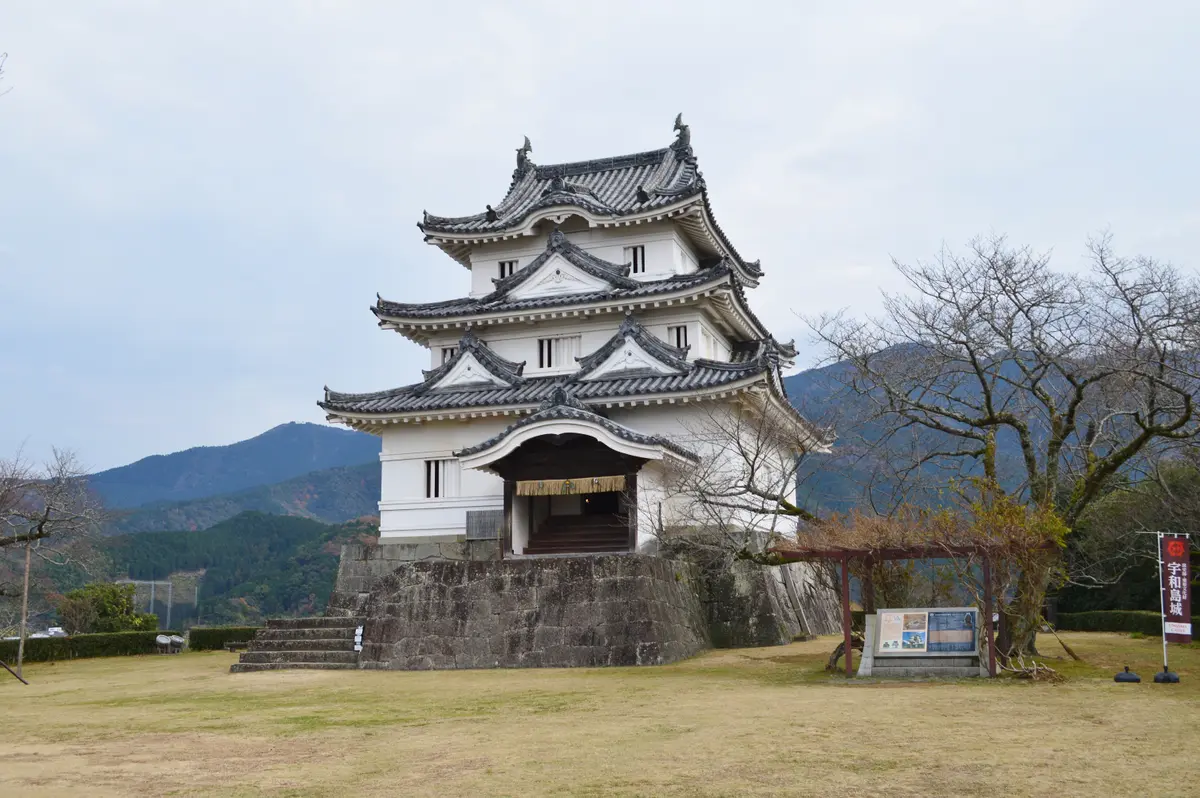
One of the twelve castles in Japan whose keep survives from the Edo period: small and white on a wooded hill in the middle of town. The stone path up takes 15 to 20 minutes, and from the keep you look out over the bay and the rooftops.

A garden around a pond, built by a lord of the Date family, the rulers of Uwajima, as his retirement retreat. Follow the path around the water; in spring, long clusters of wisteria hang from the trellises. In winter it closes on Mondays.
Uwajima's bullfights are contests between two bulls that lock horns and push until one turns away, like sumo for cattle, with no matador and no killing. You watch from the steps of a bowl-shaped arena, close to the ring. Tournaments are held only a few times a year, so check the dates first.